
Santa Rosa Parole and Probation
Parole, probation, and conditional release can all place a person in the community under rules, but they begin in different ways. The Florida Department of Corrections Office of Community Corrections supervises adults on state felony supervision. The Florida Commission on Offender Review makes decisions in older parole cases, conditional release, conditional medical release, and related matters. A Santa Rosa County judge may instead order probation as part of a criminal sentence. That court order controls the term and conditions.
Traditional parole is not the routine exit for most modern Florida prison sentences. Florida's Criminal Punishment Code generally makes parole unavailable for covered noncapital felonies committed on or after October 1, 1998. Older and special sentence classes require a close look at the offense date, judgment, FDC record, and any Commission order. “Released” alone therefore does not identify the form of supervision.
| Record type | How it begins | Best verification source |
|---|---|---|
| Parole | Commission-authorized release in an eligible case | FCOR order plus FDC supervised record |
| State probation | Court sentence supervised through FDC | FDC Supervised Population and judgment |
| Conditional release | Statutory post-prison supervision for qualifying cases | FDC record and FCOR action |
| County probation | County Court sentence, often for a misdemeanor | Santa Rosa Clerk docket and named program |
- Parole
- Discretionary supervised release granted in a legally eligible prison case.
- Probation
- A court-ordered community sentence with stated terms instead of, or after, custody.
- Discharge
- The formal end of a supervision term or legal obligation shown in the controlling record.
- Absconder
- A supervised person whose location is unknown to the agency and for whom a warrant has issued.
Check Santa Rosa County Supervision
The FDC Supervised Population search is the main public route for state felony supervision. It accepts a name or six-character DC number. A detail record can show the supervision start date, current status, supervision type, scheduled termination date, current location, and case history. FDC warns that this database does not contain ordinary county-jail records or county probation. Match the DC number, county, offense, case, and dates before treating a result as the right person.
- Search by DC number when available, or use the full name and identity details.
- Open the candidate and compare Santa Rosa County, case information, offenses, and dates.
- Read the exact supervision type and status. Do not substitute a broad label.
- Check the Santa Rosa Clerk docket when county probation or a recent court change is possible.
- Contact the assigned office when the public record is unclear or reporting details are needed.
The official community-supervision lookup is shown below. Its separate search branch helps prevent confusion with FDC's in-prison and released-inmate databases.
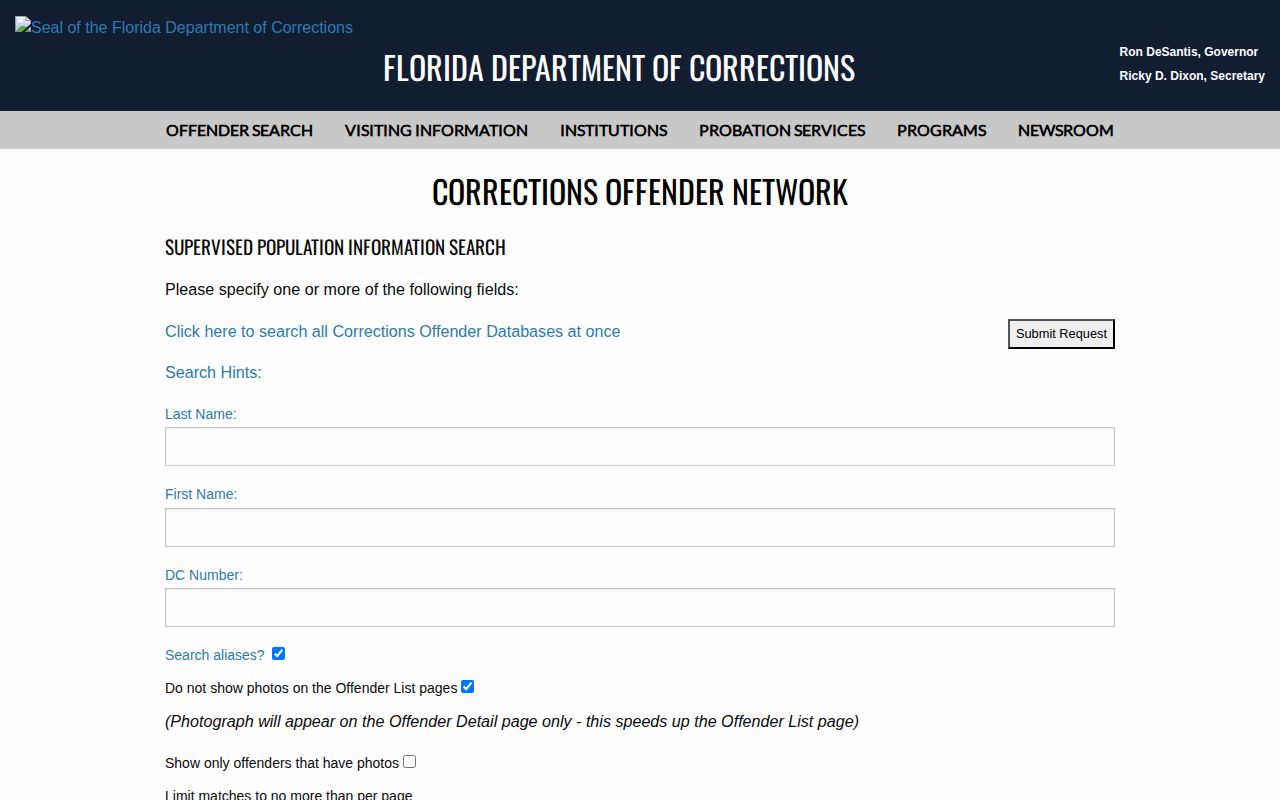
The screen is a starting point. The assigned officer and court or Commission order remain the sources for an individual's actual duties.
Santa Rosa Probation Office Details
Santa Rosa County lies in FDC Circuit 1. The local 011-Milton Community Corrections office handles adult state supervision in the area. No universal walk-in schedule was published in the research, and a general web listing does not replace instructions from the assigned officer. The circuit office in Pensacola serves Escambia, Okaloosa, Santa Rosa, and Walton Counties.
FDC 011-Milton Community Corrections6738 Caroline Street SE
Milton, FL 32570-4974
Phone: 850-983-5300
Fax: 850-983-5306
Hours: not published in the reviewed source
Questions about ambiguous supervision data may go to FDC Community Corrections at 850-717-3444 or co-supervision@fdc.myflorida.com. Release-date questions use Admission and Release instead. Documentary requests belong in the FDC public-records channel, not with a supervision officer who is managing a current case.
County misdemeanor probation is a separate boundary. If FDC returns no result, search the Santa Rosa Clerk case and read the judgment, probation order, modification, and termination entries. Juvenile supervision is also separate and generally confidential. Silence in the state felony database proves none of those duties ended.
Santa Rosa Parole Hearing Records
Florida has no Santa Rosa County parole board. The Florida Commission on Offender Review voting schedule lists dated votes, teleconferences, and conditional-medical-release matters. Each scheduled date can lead to a detailed agenda with the person's name, DC number, county, offense, case number, category, and whether a full Commission or panel will act. The cadence changes, so the live calendar is safer than assuming a fixed weekday.
The calendar shown below establishes that a matter has been set for consideration. It does not establish that parole or another release was granted.
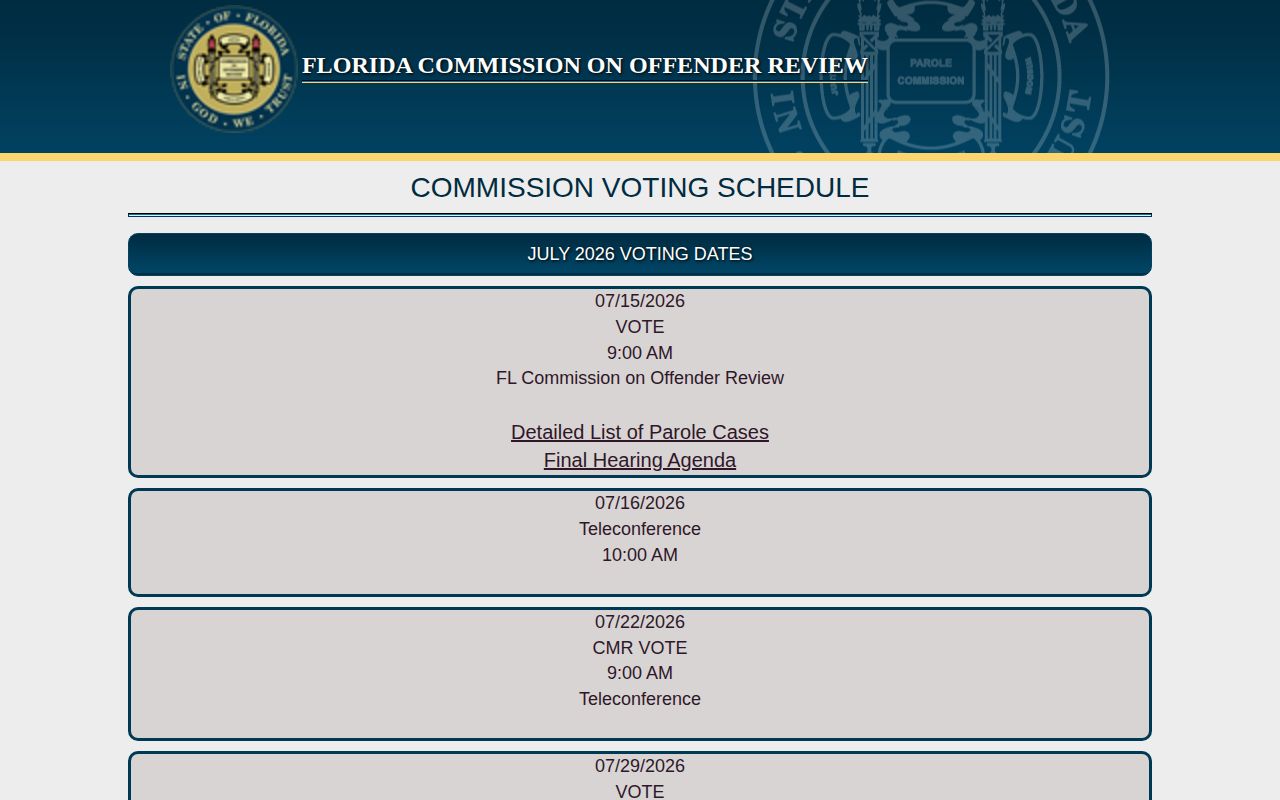
For the result, obtain the signed Commission action, final order, or minutes by name, DC number, and hearing date. Then compare the FDC Inmate Release record for the actual custody exit and Supervised Population for any ongoing term. An agenda category should never be translated into “granted,” “denied,” or “rescinded” without the order.
Florida parole eligibility also cannot be reduced to one cutoff date. Section 947.16 sets initial interview timing by sentence length, while historic offense dates, habitual-offender terms, capital offenses, and other sentence classes have separate rules. Modern Criminal Punishment Code sentences are generally parole-ineligible. Use the exact offense date and sentence before treating an interview interval as eligibility or a hearing as a release date.
Florida Commission on Offender Review4070 Esplanade Way
Tallahassee, FL 32399-2450
Phone: 850-488-2952
Fax: 850-488-0695
Santa Rosa Supervision Status Terms
Status wording can change the meaning of a Santa Rosa County supervision result. Active normally means the person is being supervised in the community. Active Suspense can mean the officer is monitoring the case while the person is unavailable for direct supervision because of jail or another facility. Absconder means the person's whereabouts are unknown to supervision and a warrant has issued. FDC also offers an Absconder/Fugitive branch, but that branch is a supervision and warrant tool, not a record of a fresh release.
Conditions vary by the governing order. Reporting, movement, treatment, payment, or other terms should be taken from the judgment, release certificate, Commission action, and assigned officer. A public search can confirm broad status. It cannot safely supply personal reporting instructions or waive a term.
Supervision ends through the action authorized for that case, such as expiration, court termination, Commission discharge, revocation, or another order. A scheduled termination date is prospective. Check the record again after that date and obtain the discharge or termination entry when formal proof is needed. The broader Santa Rosa County released inmate search and record path helps confirm whether the custody event itself was release or transfer.
Santa Rosa Release Transition Help
SRSO's current inmate handbook describes an in-jail Transition Coordinator. A person can contact that coordinator before release through the unit kiosk or a hard-copy request. The purpose-neutral help described by the sheriff includes medical navigation, veterans' benefits, Social Security benefits, and educational information. It is a practical pre-release resource, not a custody, parole, or probation database.
This distinction matters when family or counsel is trying to prepare for discharge. Transition support may address documents or service connections, while FDC and the court remain responsible for supervision status. The local program does not decide parole eligibility, change probation terms, or prove that someone has left the Santa Rosa County Detention Facility.
For a state-prison discharge into Santa Rosa County, the FDC record and assigned community office take priority. For a person leaving the county jail on probation, the sentencing order identifies the controlling program. Those channels may overlap in daily life, but their records are not interchangeable.
Property After Santa Rosa Release
The SRSO inmate handbook says property does not remain at the detention facility after release. Before release, third-party pickup uses a Hold Harmless form and generally requires one pickup of all eligible property. People sentenced to FDC keep specified identification documents and medication for transfer. That detail offers a useful custody clue: leaving the Santa Rosa jail with documents designated for FDC may be a state transfer, not a return to the community.
Record corrections also follow the office that owns the data. SRSO controls its booking and release entries. FDC Admission and Release or Central Classification handles state release and status information. The Santa Rosa Clerk controls docket documents. Send a correction or document request to the custodian that created the questioned entry.
Property procedure is separate from supervision verification. Use it to plan a lawful pickup and understand a transfer, but use FDC, FCOR, or the sentencing court to decide whether parole or probation applies.
Note: A Santa Rosa County jail exit can be a transfer, so pair property clues with the release record and destination.
Santa Rosa Absconder Warrant Checks
No county-published absconder list was found. State supervision absconders belong in FDC's search. Local warrant questions follow the sheriff's separate process. SRSO says it does not provide warrant information by telephone. A person must inquire at the front lobby with valid identification.
The sheriff also warns that its office does not call people or seek money about warrants. Treat a payment demand tied to a claimed Santa Rosa County warrant as a warning sign. Verify through the stated official process, and do not infer warrant clearance from a parole, probation, jail, or registry search that returned no match.
A warrant can affect whether someone is at liberty, available for supervision, or subject to return to custody. It does not itself establish a new release. Compare the warrant source, FDC status, court docket, and current custodian before describing what happened.