
Santa Rosa Projected Release Dates
A projected date is a forward-looking calculation. In FDC records, the public field is called Current Release Date, while statutes and rules also refer to a tentative release date. It reflects the sentence structure, credit already applied, and gain time awarded or forfeited at the time of the update. It is not a promise that the person will walk out on that date.
An actual release is a completed custody event. For a former state prisoner, FDC incarceration history can show Date Out-Custody. For a county booking, SRSO Jail View can show a Released timestamp. Neither field alone tells every destination. Transfer to another jail, FDC, federal authorities, or immigration custody ends one booking without proving a return to the community.
Bond cases require a different frame. A person awaiting trial has no sentence expiration to calculate. Court-ordered bond, payment or recognizance, release processing, and clearance of other holds determine the timing. The court docket may explain the legal authority, while the detention record supplies the physical exit time.
Find Santa Rosa Inmate Release Dates
Begin with the system that holds the person. The Santa Rosa County Detention Facility uses a local booking record. Santa Rosa Correctional Institution, its Annex and Work Camp, and Blackwater River Correctional Facility use statewide FDC records. A contracted federal prisoner housed at the county jail may still require BOP, USMS, and federal court records. The nearby facilities do not share one release database.
- Identify county, state, or federal custody and collect the booking, DC, or register number.
- For state prison, search FDC by DC number and open the detailed record.
- For a county sentence, compare the SRSO record with the Santa Rosa Clerk judgment and sentence.
- Read whether the date is future, past, unknown, to be set, or tied to a completed out-custody event.
- Check concurrent or consecutive terms, holds, detainers, and supervision or Commission action.
- Recheck after the source's update cycle and request the official computation when a discrepancy matters.
The FDC Inmate Release search includes people already released and people scheduled for release. Its presence in that branch is not enough to call someone released.
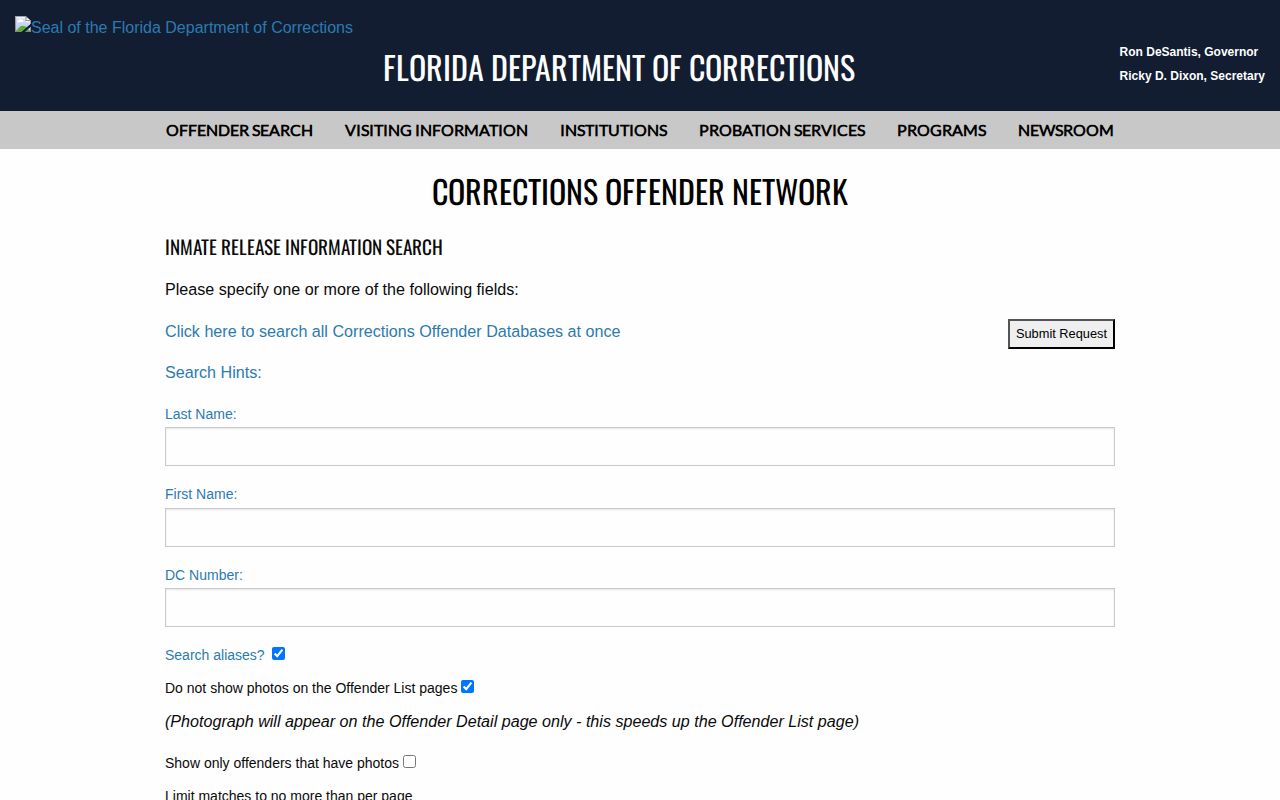
The search screen should lead to a matched detail record. Compare the DC number, photo, offense, sentencing county, case number, and custody history before using its date.
The full Santa Rosa County release search and records process explains the broader route for a person who has already left a custodian. For a date that has not yet passed, stay with the prospective fields and the agency currently doing the calculation.
Santa Rosa Release Date Systems
Three common calculations should not be blended. SRSO computes a Santa Rosa County jail sentence under the judgment, credit, holds, and any county-authorized gain time. FDC computes a state-prison date under Florida prison law and its own sentence records. BOP computes a federal date under federal law. One agency cannot certify the other agency's number.
| Custody setting | Date source | Key limit |
|---|---|---|
| County jail, pretrial | Court orders and SRSO release processing | No sentence-based projected date |
| County jail, sentenced | SRSO computation plus Clerk judgment | Do not apply FDC's 85-percent rule |
| Florida state prison | FDC Current Release Date | Subject to gain-time and sentence review |
| Federal custody | BOP projected release field | Federal law and records control |
A person can also move between systems. Commitment to FDC ends the Santa Rosa County booking but begins or continues state custody. A federal or ICE transfer has the same core issue. Request the local release method and transfer destination if the web record does not say where the person went.
Note: A Santa Rosa County Released timestamp closes that booking, but the destination determines whether the person returned to the community.
Florida State Release Computation
FDC begins with the maximum sentence expiration date, reduced by lawful jail or prison credit. Its tentative release date is the projected custody exit after granted or restored gain time. More lawful credit can move it earlier. Forfeited gain time can move it later, but the tentative date cannot run beyond the maximum expiration date. Concurrent and consecutive terms, offense-specific minimums, and court corrections may alter the calculation.
For offenses committed on or after October 1, 1995, Florida Statutes §944.275 allows eligible incentive gain time up to ten days per month but prevents gain time from producing release before at least 85 percent of the sentence has been served. Court-awarded credit for time physically incarcerated counts toward that service floor. A life sentence remains natural life absent lawful clemency or pardon.
Older award systems differ. Basic gain time applies to certain offense periods beginning in 1978 and ending in 1993. Incentive maxima changed for pre-1994 and 1994 to September 1995 offenses. Meritorious and some education awards have their own statutory limits and exclusions. That history is why a simple percentage calculator is not a sound substitute for the FDC ledger.
Misconduct may cause forfeiture. Restoration follows law and agency rules. A corrected sentence, changed jail credit, new consecutive term, detainer outcome, or FCOR action can also change the date. Ask FDC Admission and Release for an unexplained public-record change, and request the sentence structure plus gain-time computation ledger when documents are needed.
Santa Rosa Jail Date Quirks
County jail computation is a separate local research issue. Florida Statutes §951.21 authorizes county-prisoner good-conduct commutation unless the county commission discontinues or revises it. The statutory maxima rise by length of confinement: up to five days per month in the first and second years, ten days per month in the third and fourth, and fifteen days per month in the fifth and later years. Misconduct can cause forfeiture.
No reviewed Santa Rosa County commission resolution or SRSO policy established exactly how the county currently applies or revises those maxima. Do not derive an individual's jail date from the statutory table. Request SRSO's existing sentence computation, applied credit, and release record. Then compare them with the sentencing judgment from the Clerk.
The research also found no general Florida law that promises release on the prior Friday when a Santa Rosa County sentence date falls on a weekend or holiday. Processing may depend on the order, staffing, holds, and actual computation. A calendar assumption is not a release record.
This local distinction is crucial. The well-known FDC 85-percent floor applies to covered state-prison sentences, not automatically to a county jail term. Nor does either rule calculate when a pretrial bond release will finish processing.
Santa Rosa Date Change Factors
A release date can move because the facts behind the calculation move. Some changes are credits or penalties within the sentence. Others come from a court, another agency, or a release authority. The public screen may lag the underlying action.
| Factor | Possible effect | Record to check |
|---|---|---|
| Gain-time award or restoration | May move a state date earlier within legal limits | FDC computation ledger |
| Disciplinary forfeiture | May move the date later | FDC ledger and disciplinary record |
| Corrected jail credit or sentence | Can recalculate the term | Judgment, court order, agency computation |
| Consecutive sentence | May extend total custody | Sentence structure and docket |
| Detainer or outside hold | May lead to transfer instead of community release | Custodian release/transfer record |
| FCOR action | May establish, modify, defer, revoke, or discharge a term | Signed Commission order |
Use exact status words. “TO BE SET” means the FDC review is not complete. “DECEASED” is not ordinary release. “Currently Incarcerated” means appearance in the Inmate Release database has not established a completed exit. A future date remains subject to change until custody records show otherwise.
Santa Rosa Release Record Timing
FDC says its Inmate Release database updates nightly. The inmate-population database receives a full weekly refresh, while location and release-date changes update nightly. A court or institution action can therefore precede the public screen. Recheck after the update window instead of labeling a one-night difference as an error.
The official scheduled example below shows how a Current Release Date appears and warns that it may change. The FDC scheduled-release record also demonstrates why a date must be read with current custody status.
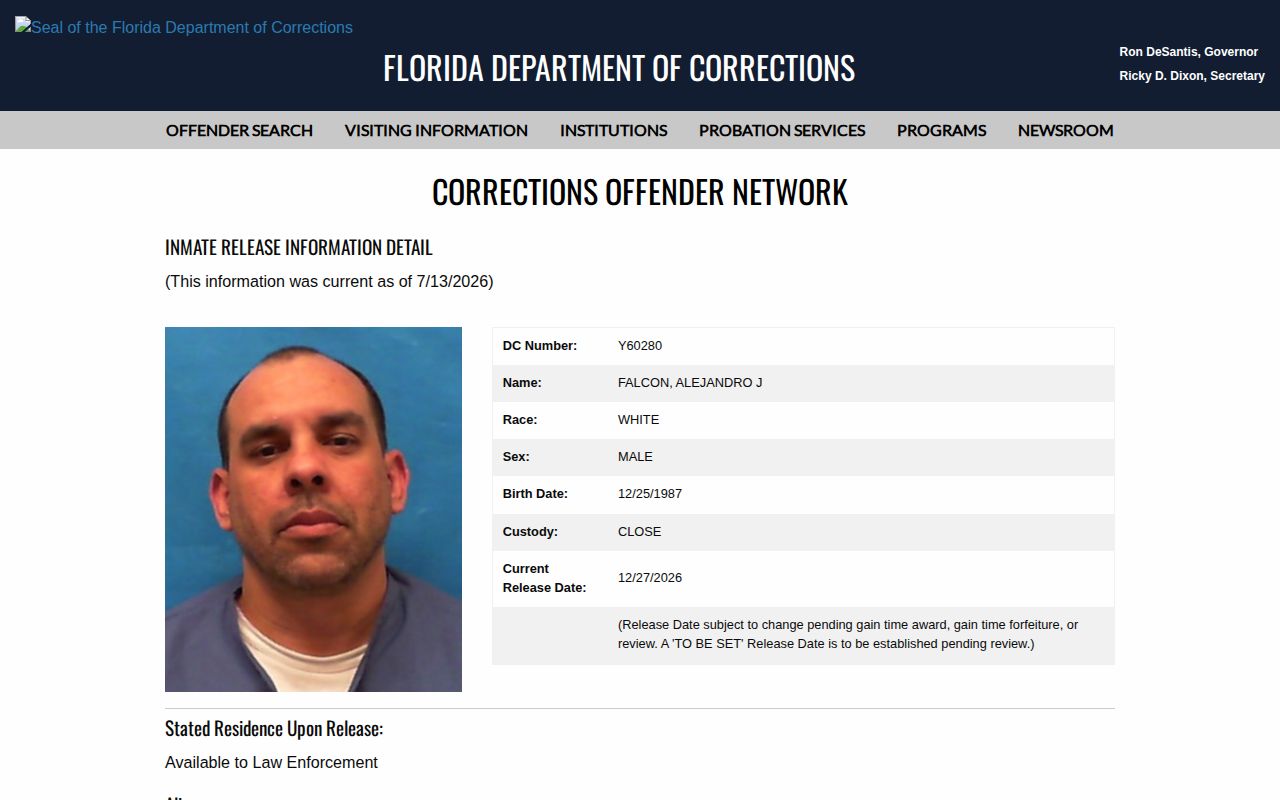
The detail screen is evidence of the agency's current calculation. It is not an assurance about transportation, a precise pickup time, or the clearance of every outside hold.
Confirm Santa Rosa Actual Release
After the projected date, return to the custodian's completed-event field. For FDC, seek a past Release Date and Date Out-Custody. For SRSO, use the Released timestamp and ask for release method or destination when transfer is possible. Read the Santa Rosa Clerk docket for the judgment, modification, bond, dismissal, or other order that explains the legal basis.
Florida VINE can send a status alert for county jail and state prison cases, but the message is a notification layer rather than a certified computation. The VINELink Release Check explains one-person search and registration. VINE does not cover BOP, USMS, or ICE, and a transfer alert should not be restated as community release.
Post-release supervision requires one more check. FDC Supervised Population can show whether a former state prisoner has an active community term, its type, start date, and scheduled end. A person can be out of prison yet remain on conditional release, parole, probation, or community control. County misdemeanor probation may appear only in the Clerk docket and the program named by the court. Neither form of supervision changes the completed prison exit, but both matter when describing the person's legal status.
FCOR schedules require care as well. A Commission agenda proves that a parole, conditional-release, medical-release, revocation, or supervision matter was calendared. It does not prove the outcome or set a final exit date. Obtain the signed action or order, then corroborate it with FDC's custody history. Modern Florida sentences are often not parole-eligible, so no date should be calculated from a generic assumption about parole.
When a date has major consequences, request the existing computation rather than asking an office to estimate. Include the full name, booking or DC number, approximate custody dates, sentence, and the specific document sought. That focused request gives the custodian a concrete record to locate and reduces same-name mistakes.
An FDC records request can name the admission and release record, release certificate, sentence structure, gain-time ledger, and transfer history. For a Santa Rosa County jail term, ask SRSO for its existing sentence computation, release authorization, applied credit, release code, and destination. The Clerk supplies the certified judgment or later order. Together, those records separate the court's sentence from the custodian's calculation and completed movement.