
Santa Rosa County Release Records
A Santa Rosa County release is the end of one custody event. It is not always a return to the community. The Santa Rosa County Sheriff's Office records the end of a local jail booking. The Florida Department of Corrections records a state-prison release or transfer. Federal agencies keep their own records. A court file explains the legal order behind many exits. Matching the agency to the booking prevents a common error: treating any disappearance from a live roster as proof that all custody ended.
Several outcomes can close a booking. A person may post bond, receive release on recognizance, complete a county sentence, obtain a dismissal or other court order, or move to another custodian. A transfer to FDC, another county, the U.S. Marshals Service, the Bureau of Prisons, or ICE ends the local booking but continues custody elsewhere. Death is also a distinct custody ending and must not be described as an ordinary release.
- Discharge
- The documented end of a custody term or supervision period.
- Time served
- A sentence outcome crediting time already spent in custody.
- Detainer
- A request or legal hold that may lead to continued custody or transfer.
- Parole
- Release from prison under Commission authority and continued supervision in eligible cases.
- Probation
- Court-ordered supervision that may be imposed instead of, or after, confinement.
Santa Rosa County Release Types
The public SRSO card gives a released date and time, status, charge data, holds, and bond fields. It may not state the full reason or destination. The court docket and requested release sheet supply that context. Read each outcome by its own meaning.
- Bond or recognizance
- Physical detention ends; check the SRSO release record and court bond order.
- Time served or sentence expiration
- The custodial term ends, subject to other holds; compare the judgment and release sheet.
- Dismissal or court order
- Custody ends under the order; obtain the Clerk docket and signed document.
- FDC commitment
- Only the county booking ends; follow the FDC DC-number record.
- Federal, ICE, or other transfer
- SRSO custody ends; identify the destination and search the new custodian.
- Parole or conditional release
- Prison confinement ends; check FDC, FCOR, and supervision records.
Note: A released timestamp proves processing out of that booking, not unrestricted return to the community or the end of every case.
Santa Rosa Release Record Fields
SRSO Jail View is the public discovery record for a county booking. Open the expanded result and compare more than the name. Booking and MNI numbers are stronger local identifiers. Charge and court details help separate two people with similar names. A photo may aid identity matching, but it does not prove current location or a case outcome.
| Field | What it shows |
|---|---|
| Released date and time | When SRSO processed the person out of that booking |
| Status | The booking's displayed custody state |
| Booking and MNI numbers | Identifiers for matching and records requests |
| Booking date | Start of the recorded local custody event |
| Charges, holds, and bonds | Case and restraint details linked to the booking |
| Court case information | A route to the legal disposition or release order |
| Photograph and descriptors | Identity aids from the booking record |
Fields can be blank. The online record may also omit the release method, authorization, or transfer destination. When those facts matter, request the booking sheet, release sheet, release code, authorization, destination, and any nonexempt photograph. The exact online retention period is not promised, even though the form supports historic release-date searches.
Request Santa Rosa Release Records
Send sheriff-record requests to SRSO, not county administration. Florida public-record law does not require a requester to explain a purpose, and a request need not use a form. A clear written request still helps staff locate the existing record. Give a full name, booking number, and approximate date. Ask for the exact record categories rather than asking staff to research what happened.
- Check SRSO Jail View and record the booking or MNI number.
- Open the SRSO public-records portal.
- Request the booking and release sheets, date and time, method or code, authorization, transfer destination, and nonexempt photo.
- Ask for electronic copies and request a cost estimate before extensive work.
- Compare the response with the Clerk case when the legal basis remains unclear.
The official request form shows the channel used for sheriff-held Santa Rosa County release records.
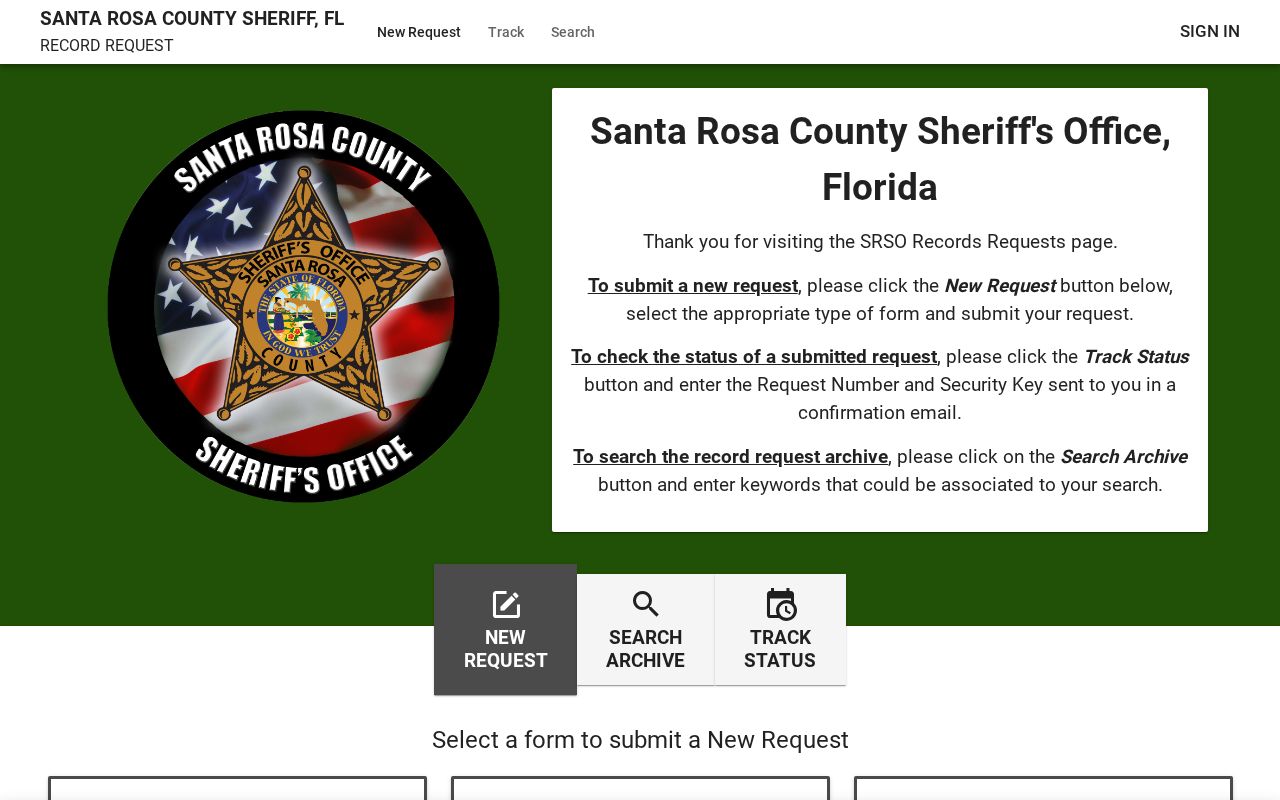
A focused request reduces same-name risk and lets the custodian apply any lawful exemption or redaction to the identified material.
5755 East Milton Road
Milton, FL 32583
850-983-1268
Published records hours were not found; call first.
Santa Rosa Release Record Law
Florida Chapter 119 provides broad access to nonexempt public records. It calls for prompt acknowledgment and a good-faith response, not a fixed deadline. Standard paper charges may reach 15 cents for a one-sided page, with added lawful charges for other media, certification, or extensive staff and technology use. Court-copy fees follow the Clerk's separate statutory schedule.
Sealed, expunged, juvenile, exempt, and protected records can be withheld from ordinary public view. Search silence is not proof of release.
Florida's GS2 schedule sets a minimum of one anniversary year after release for booking records, commitment and release lists, and incarceration files. That agency-retention rule does not require continuous web display. Court records often last far longer under Rule 2.430. A failed old Jail View search should lead to SRSO records and the Clerk docket, not a guess.
Santa Rosa County Bond Release
The SRSO handbook distinguishes professional bond, recognizance, pretrial release, signature or property bond, and cash bond. A professional bond uses a licensed bondsman. The handbook states a fee of ten percent with a $100 minimum and says the fee is not returned. A cash bond is handled differently and may be returned after the case, subject to qualifying fines or costs. The court's terms still control each person.
SRSO also publishes an authorized bond-company list. A bond transaction does not close the criminal case. Pair the released timestamp with the bond order and docket. If another hold exists, satisfying one bond may not produce community release. This distinction is especially important when the booking lists several charges or another agency's hold.
Santa Rosa Release Property Rules
The local inmate handbook says property is not kept at the detention facility after release. Before release, a third party can collect eligible property through the described Hold Harmless process and generally must take all eligible items at once. A person transferring to FDC keeps specified identification documents and medication for transfer, while clothing may be released. That property handling can be a practical clue that leaving SRSO did not mean returning home.
Record corrections follow the data owner. SRSO handles its booking or release entry. FDC Admission and Release or Central Classification handles state custody data. The Clerk handles docket documents. Send a precise correction request to the office that created the disputed field and include the matching identifier.
Fees After Santa Rosa Release
The current SRSO handbook describes a one-time $20 booking or per-diem charge and a $2 daily subsistence charge under Florida section 951.033. It says an unpaid balance may enter the stated billing process 14 days after release and that added payment fees may apply. People housed for USMS, FBOP, ICE, or another paying agency are exempt from those two jail charges.
These charges are a financial result of a booking. They are not a search fee and do not change access to the public Jail View record. A records request may have separate copy or extensive-service costs under Chapter 119. Ask for an estimate before agreeing to broad production.
Find Santa Rosa County Releases
Start with the system that last held the person. For a county booking, the official SRSO bridge leads to SmartWEB. Select Released Inmates Only, add a name when known, and use a release-date range. The default result says BOOKED Last 24 Hours. That is a booking feed, not a release list.
- Search SRSO released-only records and open the likely booking.
- Match the booking number, MNI number, date, charges, and photograph.
- Read the Released timestamp, holds, and charge details.
- Search the Santa Rosa Clerk case for the order or disposition.
- Check FDC, BOP, or ICE if transfer to another custodian is possible.
- Request the release code and destination when the public record remains unclear.
The official SRSO Jail View page is the county entry point.
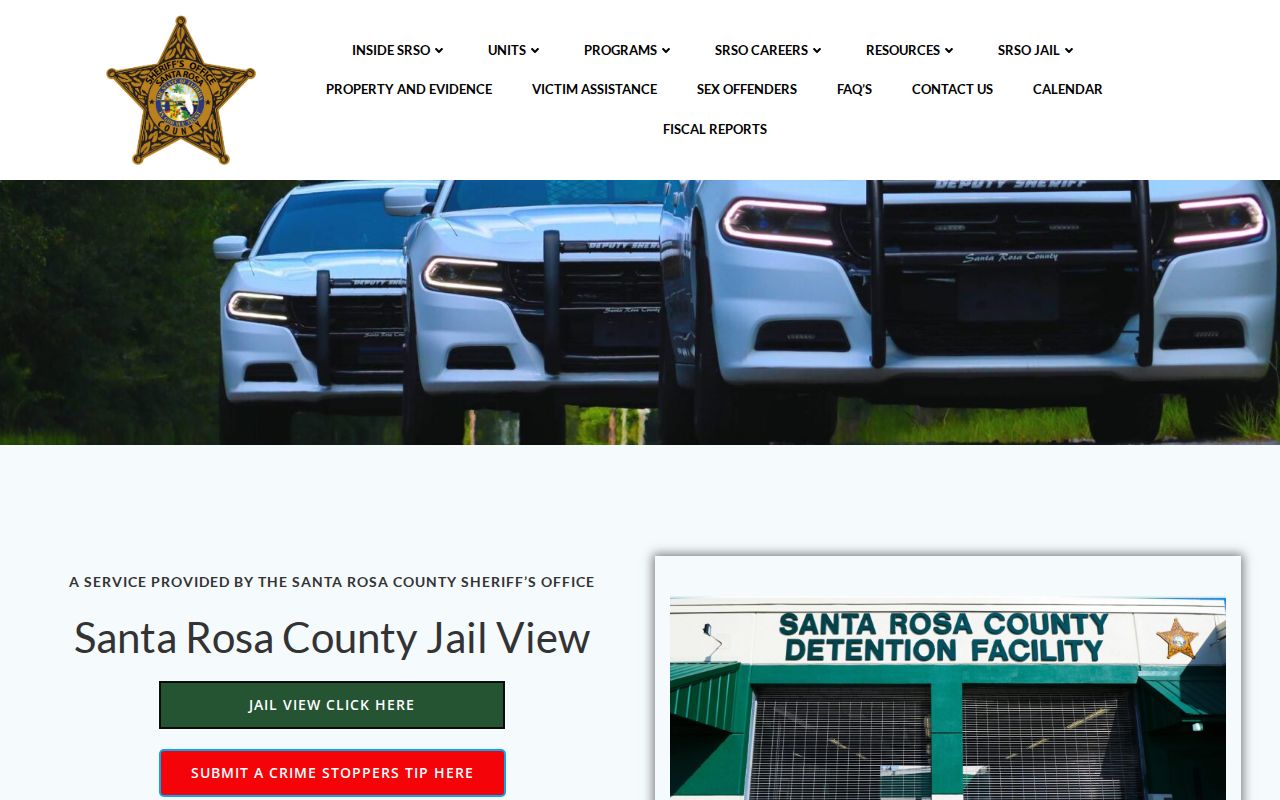
Following the sheriff's bridge helps distinguish the official county tool from unofficial copies that may lag or preserve corrected data.
A released person usually leaves a current-inmate roster. Use the released-only archive, court record, and correct next-custodian system instead.
Santa Rosa Release Court Records
The Clerk record often explains why jail custody ended. Search by name or case number, then compare the charge and booking information. Useful entries include bond orders, dismissal or nolle prosequi, judgment and sentence, jail credit, probation, FDC commitment, modification, and discharge. A closed case does not supply the jail-door time, so pair it with the SRSO Released field, an FDC Date Out-Custody, or a VINE event.
The Santa Rosa Clerk search gateway leads to anonymous public access and registered routes.
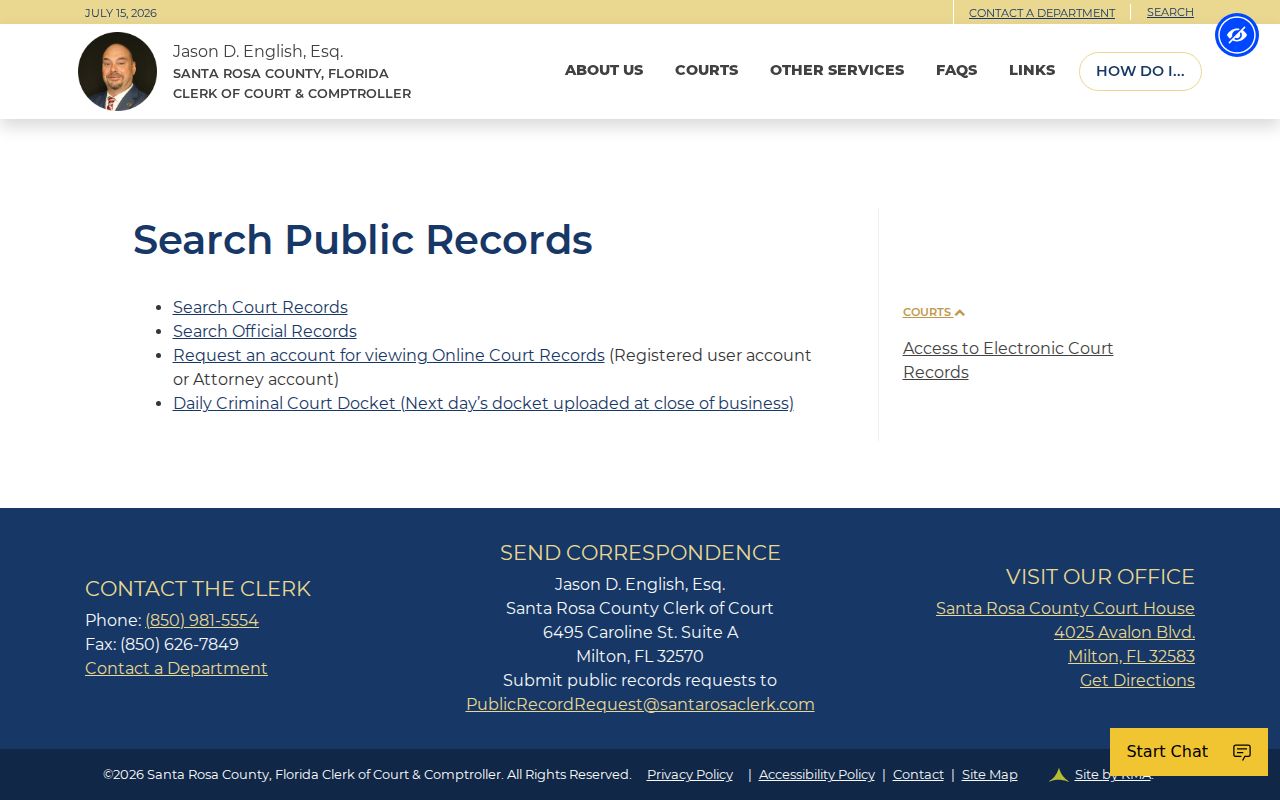
Some older document images remain unavailable while backscanning continues. The local copies form includes a specific Judgment/Sentence option, plus arrest report, charging information, entire file, or another named document. Ordinary copies are listed at $1 per page and certified instruments at $2, with other charges under section 28.24.
Florida Search for Santa Rosa Releases
Use the FDC Offender Search for a person who entered Florida state prison. It covers Santa Rosa CI, its Annex and Work Camp, Blackwater River, and other FDC institutions. It does not replace SRSO Jail View for someone who only bonded out of the county jail.
| Search field | Use | Notes |
|---|---|---|
| DC number | Strongest state identifier | Six-character FDC number |
| Name | Broad person search | Confirm with other fields |
| Race, sex, age | Narrow same-name results | Inputs vary by search branch |
| Release-date range | Released or scheduled records | Available in the release branch |
| County of commitment | Sentence context | Not the same as release county |
A detailed record can show a photo, offenses, counties, case numbers, status, Current Release Date, and incarceration history. For a completed release, look for a past Release Date and Date Out-Custody. A future Current Release Date is subject to recalculation. Then search the supervised-population branch for continuing community control.
The FDC search-family gateway visibly separates incarcerated, released, supervised, fugitive, and absconder records.
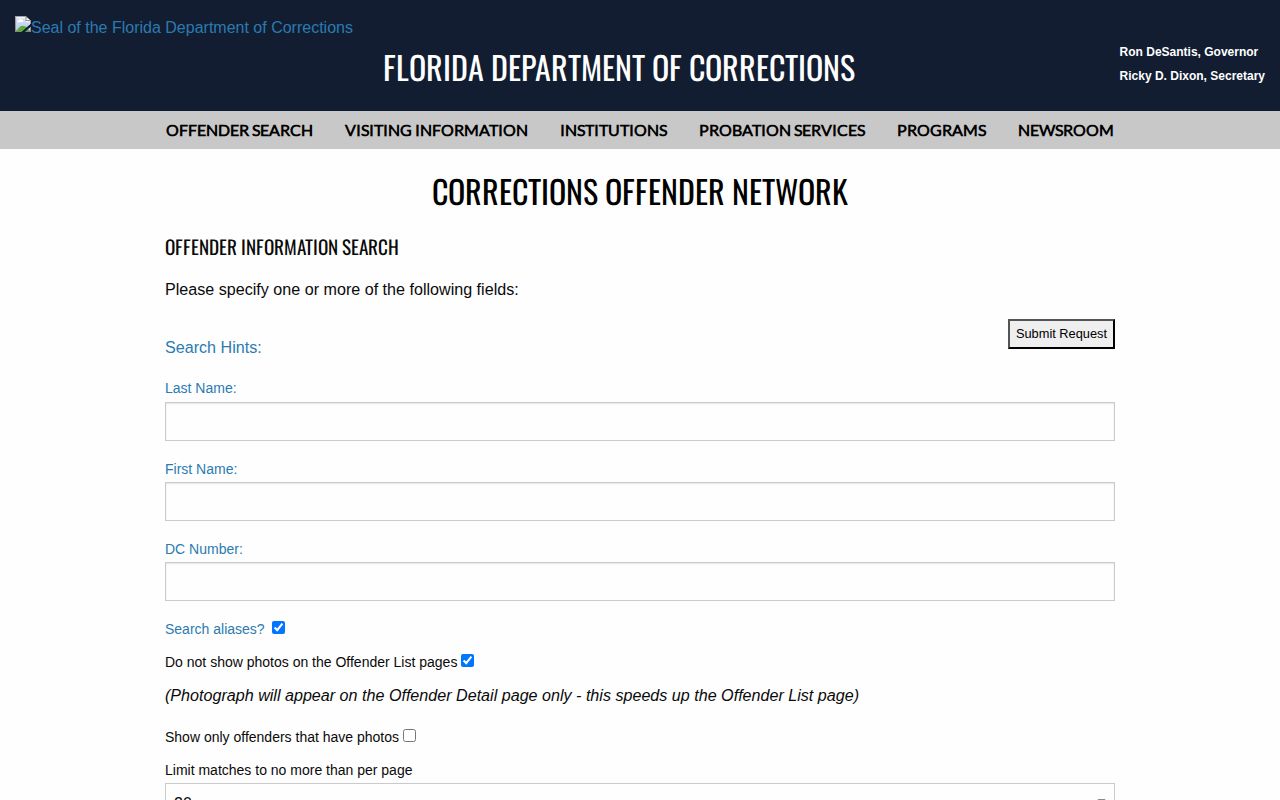
Choosing the matching branch prevents a county release from being mistaken for a state-prison discharge.
Santa Rosa Post-Release Supervision
FDC Community Corrections supervises adults on state felony supervision. FCOR makes decisions in parole, conditional release, conditional medical release, and related matters. Traditional parole is not the standard release route for most modern Florida sentences. Search FDC Supervised Population by name or DC number and match the county, case, offense, and dates.
Active means active community supervision. Active Suspense can reflect temporary custody elsewhere while the officer monitors the case. Absconder means the person's location is unknown to supervision and a warrant has issued. Misdemeanor county probation may not appear in FDC, so the Clerk order remains necessary. The local route and status terms are covered in the Santa Rosa parole and probation record.
Santa Rosa Release Transition Help
SRSO identifies a Transition Coordinator inside the jail. A person can make contact before release through the facility kiosk or a paper request. The handbook describes purpose-neutral help with medical navigation, veterans' benefits, Social Security benefits, and educational information. This is a planning channel. It is not a release-status search and cannot replace the official booking, court, or custody record.
Property, transport, identification, medication, and supervision plans may depend on whether the person returns to the community or transfers to FDC. Ask the releasing or receiving agency about an individual plan. Do not infer a destination from program participation alone.
Transportation After Santa Rosa Release
Santa Rosa County does not have a current fixed-route public bus system. The Highway 90 pilot ended in December 2012. The county instead identifies Tri-County Community Council door-to-door transportation for qualifying residents at 850-626-6806. Eligibility and scheduling must be confirmed directly.
The county transit page documents that limited local transportation setting.
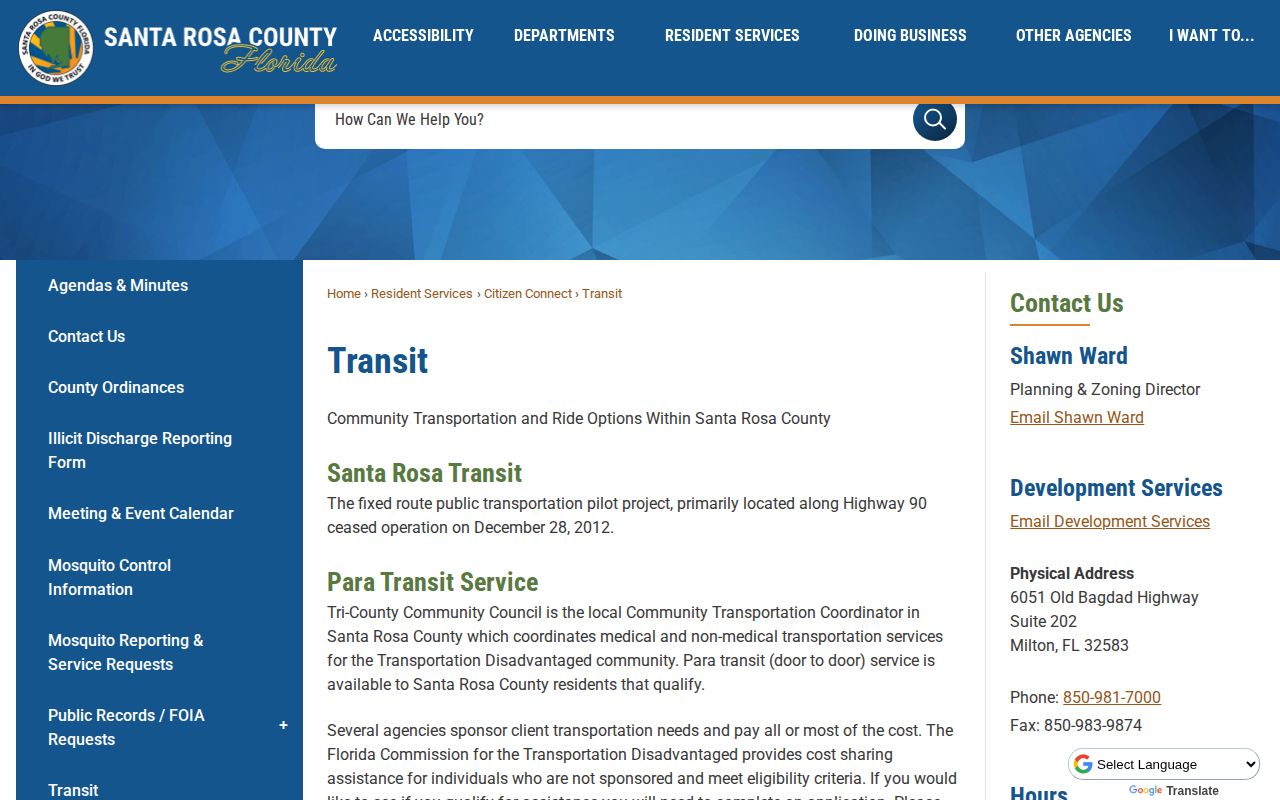
A release plan should not promise a bus stop near the East Milton jail. Pickup arrangements, approved door-to-door service, or another lawful ride should be confirmed before the expected event.
Santa Rosa Federal Release Checks
SRSO houses some USMS and FBOP prisoners under contract. A movement out of the county jail does not prove federal custody ended. Search the BOP Inmate Locator by register number when possible. A past date with Released or Not in BOP Custody confirms the BOP event, but it does not end state, local, immigration, or federal supervision obligations. USMS has no public name-based release locator, so the federal docket and focused agency records request may be needed.
An ICE detainer can lead to a transfer after the ordinary local release point. The ICE locator may include current detainees and some people released within the last 60 days, but its records can lag or be omitted. The Tallahassee check-in office covers Santa Rosa County, yet it is not a detention or release desk. Search ICE and SRSO separately, then request the SRSO destination if the path is unclear.
What if no locator returns a result? Recheck spelling, aliases, identifiers, date ranges, and the suspected custodian. Search the court file and request archived records. A no-result can also reflect sealed, expunged, juvenile, protected, old, or delayed data.
Where Santa Rosa Releases Appear
The county jail, state prison, federal system, immigration system, and youth system remain separate even when facilities are close together. Use this custody boundary before drawing a conclusion.
| Situation | Primary source | What confirms release |
|---|---|---|
| Current county detainee | SRSO current search | In-custody status, not a release |
| Released county booking | SRSO released-only range | Released timestamp plus destination context |
| Florida state prisoner | FDC offender search | Date Out-Custody and release record |
| Federal prisoner | BOP locator and federal docket | BOP release result and court record |
| Immigration detainee | ICE ODLS and agency record | ICE status, subject to locator limits |
| Santa Rosa youth | Authorized DJJ and juvenile court channels | Confidential process, not adult rosters |
Santa Rosa County Release Facilities
Several detention systems operate in or serve Santa Rosa County. Their closeness around Milton does not merge their records. SRSO uses booking and MNI numbers. FDC uses DC numbers. The youth center follows confidential DJJ rules.
- Santa Rosa County Detention Facility: county releases, court-ordered exits, and agency transfers.
- Santa Rosa Correctional Institution: FDC state-prison records.
- Santa Rosa Correctional Institution Annex: the same statewide FDC record.
- Santa Rosa Work Camp: FDC placement or release, not a county roster.
- Blackwater River Correctional Facility: contract operation under FDC authority.
- Escambia Regional Juvenile Detention Center: authorized confidential youth channels.
Blackwater's private operator does not make its records county or federal. A move among Santa Rosa CI, its Annex, Work Camp, or another FDC institution can be an internal transfer rather than a release. Confirm a completed prison exit in the statewide offender history.