
Authorized Juvenile Release Paths
Escambia Regional Juvenile Detention Center is operated by the Florida Department of Juvenile Justice. It serves Escambia and Santa Rosa Counties. The center is part of the regional youth detention system, not the adult Santa Rosa County jail and not the Florida adult state-prison system. That distinction controls every custody and release inquiry.
A youth's next step can depend on a juvenile-court order, DJJ placement decision, detention review, probation status, or another authorized action. Public adult terms such as released inmate, county booking, and FDC discharge do not map neatly onto confidential juvenile proceedings. The reliable record is the one available through DJJ, counsel, the juvenile court, or another authorized participant who can lawfully receive it.
| Question | Authorized route |
|---|---|
| Current youth placement or status | DJJ or the center through an authorized contact |
| Court basis for detention or release | Juvenile counsel and the juvenile court case |
| Probation or supervision | Assigned DJJ channel, not adult FDC search |
| Records access | Request through the lawful juvenile process for the requester's role |
Confirm Youth Release Lawfully
There is no public adult released-inmate lookup to substitute for an authorized juvenile inquiry. Start by identifying the relationship to the youth and the court case. A parent or guardian, retained or appointed lawyer, and agency participant may have different access rights and verification steps. The facility or DJJ can route a lawful inquiry without publishing protected facts.
- Confirm that the youth's matter is connected to Santa Rosa County and the regional detention center.
- Use the official DJJ facility contact for operational routing permitted to the caller.
- Contact the youth's lawyer for the detention or release order and the next court requirement.
- Use the juvenile court channel connected to the case when access is authorized.
- Keep the information private and follow any identity or relationship verification requested by the custodian.
Do not try to validate the event through SRSO Jail View, FDC Offender Search, VINELink's adult workflow, BOP, or a public registry. Those systems were researched for adult custody and do not become valid youth-release sources merely because they return no match. The Santa Rosa County adult custody overview is useful only for understanding why those adult systems are separate, not for looking up a juvenile.
Note: The authorized source may confirm only what the requester's role permits, and a limited answer should not be treated as a data gap.
Escambia Juvenile Release Contact
The official DJJ listing identifies the regional center, its location, phone, and service area. Calling the center does not guarantee disclosure of a youth's status. Staff may need to verify identity, relationship, legal authority, or case involvement before sharing any protected information. That safeguard is part of the correct process.
Florida Department of Juvenile Justice
1800 St. Mary Avenue
Pensacola, FL 32501
850-595-8820
Serves Escambia and Santa Rosa Counties
For the legal basis of a youth's detention or release, work through counsel and the juvenile court. Florida court-access rules protect confidential court records and provide procedures for access. The Santa Rosa Clerk handles Circuit Court matters, including juvenile delinquency, but public adult case-search visibility must not be assumed. An authorized requester should identify the case accurately and ask the Clerk which protected-access process applies.
Do not frame a juvenile request as a broad public-record search for all youth or a recent-release list. A narrow, role-based request for an identified case or order is more consistent with confidentiality. If the caller lacks authority, the correct result may be no disclosure rather than a public substitute.
Escambia Juvenile Release Service Area
The official DJJ center page documents that the Pensacola facility serves both Escambia and Santa Rosa Counties.
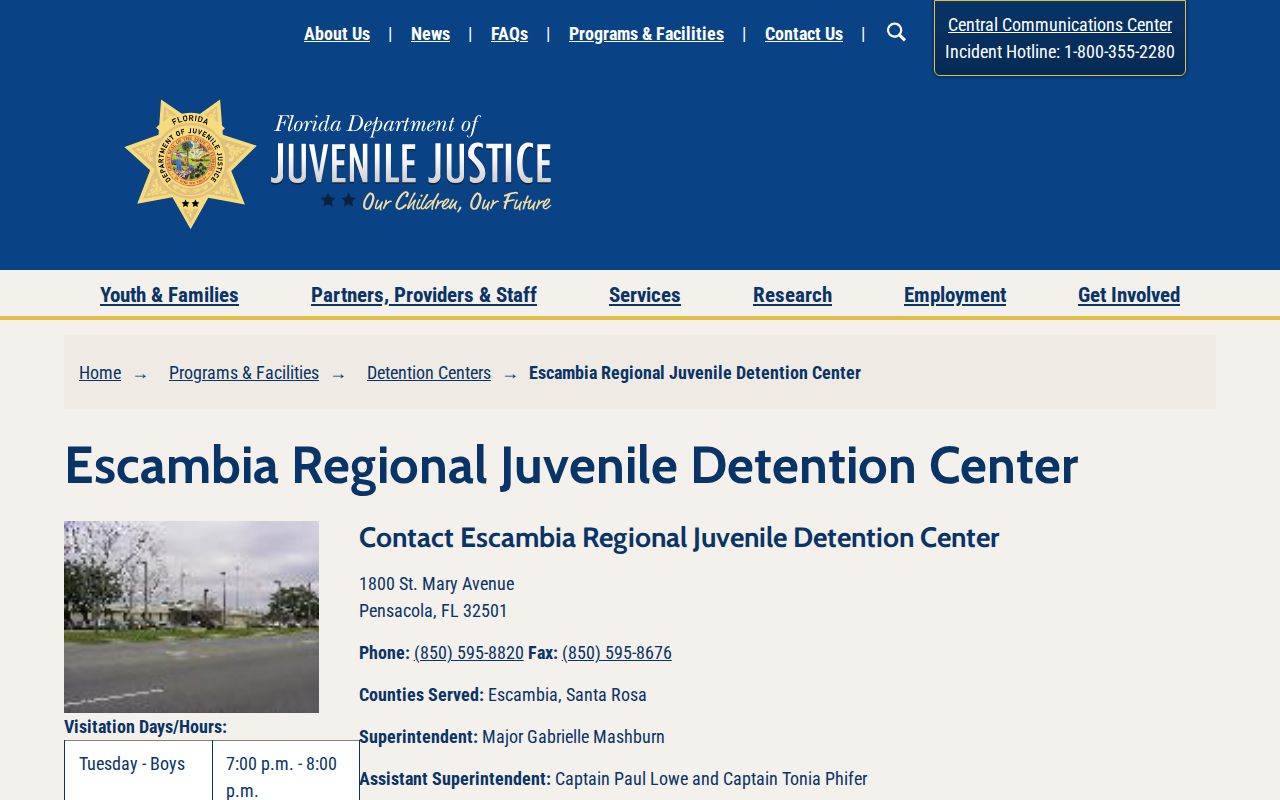
The image confirms the regional assignment and contact point, not the status or release of any individual youth.
Including the center in Santa Rosa County's facility map reflects service, not geography. It stands outside Santa Rosa County in Pensacola. A youth from Santa Rosa can therefore have a local court case tied to a regional detention site in another county. That arrangement makes the case number, assigned lawyer, and DJJ contact more useful than searching by county name on an adult roster.
The regional model also explains why no separate Santa Rosa youth release list should be expected from SRSO. The Sheriff's Office detention records concern the adult county facility. DJJ youth information follows its own rules and operational chain. Keeping the two apart protects accuracy and confidentiality.
Note: The facility's service-area listing establishes jurisdictional relevance but does not authorize public access to any youth's record.
Escambia Juvenile Release Confidentiality
Juvenile custody, probation, and court records are subject to distinct confidentiality provisions. Some information may be available to a parent, guardian, counsel, party, or specified agency, while public access may be restricted. The precise right depends on the record, proceeding, and requester's legal role. General statements about adult booking photos or public jail releases should not be imported into this setting.
A sealed, protected, or unavailable result has a narrow meaning: the public channel does not provide the information. It is not proof that the youth was never detained, remains detained, was released, or entered probation. The same caution applies to a name that never appears in adult SRSO or FDC results. Those databases are simply outside the correct juvenile route.
- Juvenile detention
- Secure youth custody administered under the juvenile justice system.
- Authorized requester
- A person or entity whose legal role permits access to specified protected information.
- Juvenile court order
- The case-specific judicial record that may govern detention, release, placement, or supervision.
- Confidential record
- Information withheld from ordinary public access under applicable law or court rule.
Escambia Juvenile Release Database Limits
SRSO Jail View contains adult county booking records and offers a Released Inmates Only filter. It does not become a juvenile database. FDC Offender Search covers the adult state corrections system. Its inmate, released, supervised, fugitive, and absconder branches should not be presented as youth custody sources. BOP and USMS concern federal adult custody routes described in the research, not this DJJ facility.
VINELink can be valuable for covered adult county-jail and FDC events, yet the researched specific-person workflow does not authorize treating it as a substitute for confidential DJJ information. State registries cover only people who meet narrow registration laws. They are not a general juvenile release list and cannot prove release or detention.
When an adult database shows no name, stop. Do not broaden the search across public systems in hopes of finding protected youth information. Return to the authorized DJJ, counsel, and juvenile-court path. That is both more accurate and more respectful of the rules governing the record.
Escambia Juvenile ICE Release Limits
The ICE detainer and transfer angle documented for the adult Santa Rosa County Detention Facility does not create a juvenile lookup route. ICE ODLS excludes minors according to the researched federal guidance. Its absence therefore says nothing about a youth served by Escambia Regional Juvenile Detention Center.
Likewise, the ICE Tallahassee check-in office is not a juvenile detention facility or release desk. It cannot confirm a DJJ placement. Adult local-to-ICE transfer procedures must not be copied onto youth records without case-specific lawful information from an authorized source.
If immigration issues arise in an individual juvenile matter, the youth's lawyer and authorized agencies are the proper route. No public inference should be made from ODLS, an adult jail entry, or a check-in office listing. The facility contact, counsel, and court remain the sound custody and release channels.
Note: The adult ICE transfer framework is explained here only to prevent its misuse as a public juvenile search method.
Describe Youth Release Carefully
When an authorized source provides information, repeat only what it establishes. A court order may direct release, placement, or supervision. A DJJ contact may confirm a status within the limits allowed to the requester. Counsel can explain how an order affects the youth's case. None of those facts should be enlarged into a public profile.
A precise account identifies the source, date, and scope without exposing protected detail. “The authorized court channel confirmed the detention order changed” is different from claiming the youth returned home. A move to another placement may end detention at the regional center while continuing agency control. Juvenile probation may also follow release from secure detention.
If the record cannot be accessed, the correct conclusion is that public verification is unavailable. Do not fill the gap with adult sources, social posts, or guesswork. Escambia Regional Juvenile Detention Center serves Santa Rosa County youth through a confidential system, and the verification process must remain within that system.